Ask ten marketers what SaaS marketing is, and you’ll probably get ten different answers.
Some will say it’s SEO. Others will tell you it’s paid advertising, content marketing, email campaigns, or product-led growth. While all of those play a role, they don’t define SaaS marketing.
After nearly two decades in technology and years leading B2B SaaS marketing and marketing operations, I’ve come to believe that the biggest misconception about SaaS marketing is that it’s treated as a lead generation function.
It isn’t.
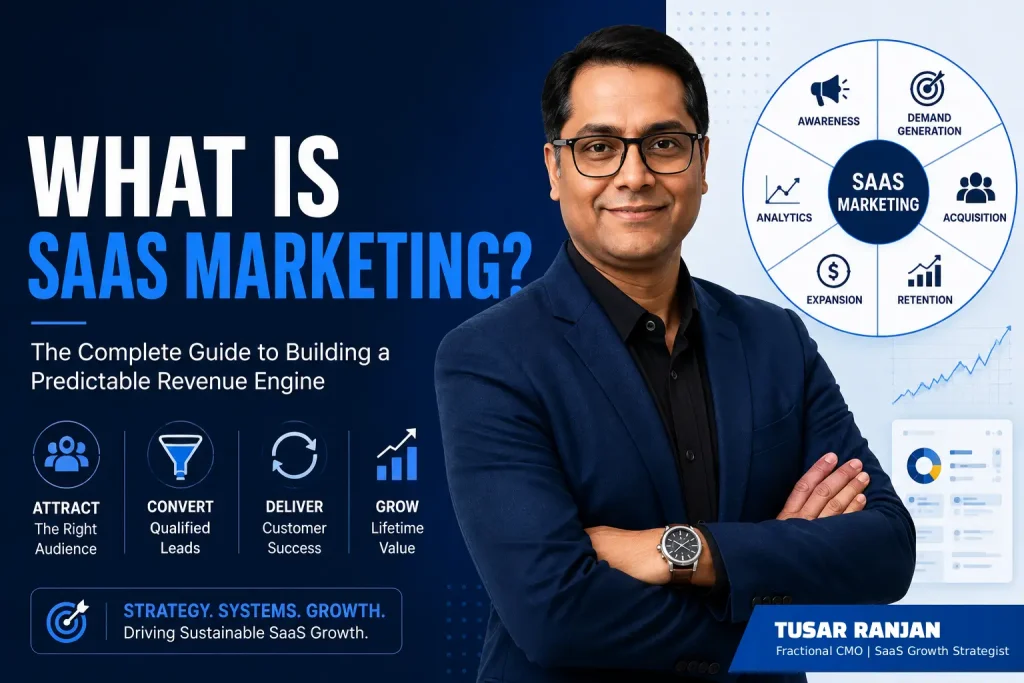
SaaS marketing is the process of building a predictable revenue engine that attracts, converts, retains, and expands customers throughout the entire customer lifecycle using data, technology, and continuous optimization.
It’s not about generating more leads. It’s about building repeatable systems that create sustainable Annual Recurring Revenue (ARR).
This shift in thinking changes everything.
Instead of asking, “How do we generate more leads?”, successful SaaS companies ask:
- How do we acquire the right customers?
- How do we improve conversion across the entire funnel?
- How do we retain customers longer?
- How do we increase customer lifetime value?
- How do we build predictable revenue month after month?
If you understand that difference, you already understand what separates SaaS marketing from traditional digital marketing.
What Is SaaS Marketing?
SaaS marketing is the complete business system that helps software companies acquire, convert, retain, and grow customers while maximizing recurring revenue.
Unlike traditional marketing, SaaS marketing doesn’t stop after a customer signs up or purchases a subscription. In many ways, that’s where the real work begins.
Every marketing decision should contribute to long-term business growth, not just short-term campaign performance.
That means SaaS marketing includes:
- Understanding the right customer
- Building strong positioning
- Creating an effective go-to-market strategy
- Optimizing the website and conversion experience
- Generating qualified demand
- Supporting sales
- Improving onboarding
- Increasing product adoption
- Reducing churn
- Growing customer lifetime value
In other words, SaaS marketing is not one department or one channel. It’s the complete operating system that turns product value into predictable recurring revenue.
Why Most SaaS Founders Get Marketing Wrong
The biggest mistake I see founders make is treating SaaS marketing as a lead generation function instead of a revenue growth system.
When growth slows down, the first reaction is usually to increase advertising budgets, publish more content, hire another agency, or launch additional campaigns.
The assumption is simple:
More campaigns will generate more leads.
Unfortunately, that’s rarely the real problem.
In my experience, most SaaS companies don’t have a traffic problem.
They have a conversion problem.
They haven’t clearly defined:
- Their Ideal Customer Profile (ICP)
- Their positioning
- The buyer journey
- Conversion paths
- Lifecycle marketing
- Customer retention strategy
When those foundations are missing, increasing traffic simply exposes a broken funnel.
I often tell founders:
More traffic doesn’t fix a broken funnel. It simply sends more people into it.
That’s why I always recommend fixing the demand engine before increasing marketing spend.
My Biggest Lesson from B2B SaaS Marketing
One experience fundamentally changed how I think about SaaS marketing.
While leading marketing operations at Deltek–Replicon, the initial assumption was familiar.
We believed we needed more campaigns to generate more leads.
Instead of immediately launching additional campaigns, we analyzed the entire marketing funnel.
The data told a very different story.
The biggest bottleneck wasn’t traffic.
It was conversion.
We discovered several issues across the customer journey:
- Landing pages weren’t optimized for intent.
- The website experience created unnecessary friction.
- Lead routing wasn’t consistent.
- Marketing automation required improvement.
- The handoff between marketing and sales created delays.
- Lead nurturing workflows needed refinement.
Rather than increasing campaign spend, we rebuilt the marketing foundation.
Our focus shifted toward improving the system.
We optimized high-intent landing pages, improved website performance, implemented better GA4 funnel tracking, strengthened HubSpot and Salesforce automation, refined lead scoring, and improved lifecycle nurturing.
The results were significant.
We improved MQL-to-SQL conversion by 32% while increasing qualified pipeline contribution by approximately 20%—without relying solely on additional marketing spend.
That experience completely changed my perspective.
Since then, every SaaS engagement starts with the same principle:
Sustainable growth comes from fixing the demand engine—not simply launching more campaigns.
How Is SaaS Marketing Different from Traditional Digital Marketing?
Many companies assume SaaS marketing is simply digital marketing for software companies.
I disagree.
The biggest difference is that SaaS marketing isn’t about generating a transaction.
It’s about building predictable recurring revenue.
Traditional digital marketing often focuses on metrics such as:
- Traffic
- Clicks
- Cost per click
- Leads
- One-time purchases
SaaS marketing measures success very differently.
Instead of asking, “How many leads did we generate?” successful SaaS companies ask:
- Did we acquire the right customers?
- Are they activating quickly?
- Are they staying longer?
- Are they expanding their accounts?
- Is customer lifetime value increasing?
- Is our acquisition becoming more efficient?
The mindset shifts from campaign performance to business performance.
That’s why I believe the best SaaS marketers think more like business operators than channel specialists.
They don’t optimize individual campaigns.
They optimize the entire customer lifecycle.
The Mindset Shift That Changed My Career
Earlier in my career, I believed great marketing was about executing great campaigns.
Today, I believe great marketing is about designing great systems.
Campaigns matter.
Creative matters.
SEO matters.
Paid media matters.
But none of those create predictable growth on their own.
Predictable growth happens when every part of the business works together:
- Product
- Marketing
- Sales
- Customer Success
- Revenue Operations
When those teams operate as one system, marketing becomes a predictable revenue engine instead of a cost center.
That’s the transformation I hope every founder makes.
I don’t want SaaS leaders to think of marketing as SEO, PPC, LinkedIn campaigns, webinars, or content marketing.
I want them to see marketing as the system that connects customer acquisition, customer retention, and customer expansion into one measurable growth engine.
What Does SaaS Marketing Actually Include?
Many founders think SaaS marketing is simply about attracting visitors and generating leads.
In reality, it’s much broader.
SaaS marketing includes everything required to acquire, convert, retain, and grow customers profitably.
It’s not one department or one channel. It’s the complete system that transforms product value into predictable recurring revenue.
To understand how that system works, let’s break down the eight pillars I believe every successful SaaS marketing engine should be built on.
The 8 Pillars of a Successful SaaS Marketing Strategy
When I work with SaaS companies, I rarely start by discussing SEO, paid advertising, or social media.
Instead, I start by evaluating the entire growth system. Over the years, I’ve found that successful SaaS companies consistently build their marketing around eight foundational pillars. Every campaign, channel, and initiative sits on top of these pillars.
1. Product-Market Fit and Ideal Customer Profile (ICP)
Everything starts here.
Before spending a single dollar on marketing, you need absolute clarity about who your ideal customer is and why they should choose your product.
I always begin by answering questions like:
- Who gets the most value from this product?
- What business problem are we solving?
- Which industries convert the fastest?
- Who are the decision-makers?
- Why do customers choose us instead of competitors?
If the Ideal Customer Profile isn’t clearly defined, every marketing activity becomes less effective. Paid campaigns become expensive, SEO attracts the wrong audience, and sales spends valuable time speaking with prospects who were never a good fit.
I’ve learned that marketing doesn’t fail because channels stop working. It fails because companies try to market to everyone.
2. Positioning, Messaging, and Category Narrative
One of the biggest weaknesses I see in SaaS companies is messaging.
Most businesses spend too much time explaining what their software does and not enough time explaining why it matters.
Strong positioning answers three simple questions:
- Why this product?
- Why now?
- Why us?
Your homepage, landing pages, sales presentations, advertisements, webinars, and email campaigns should all reinforce the same value proposition.
When positioning is clear, marketing becomes significantly easier because customers immediately understand the value your product creates.
3. Go-to-Market Strategy
A great product doesn’t guarantee growth.
Growth happens when the right product reaches the right customer through the right channels at the right time.
That’s exactly what a Go-to-Market (GTM) strategy is designed to accomplish.
A strong GTM strategy includes:
- Customer acquisition channels
- Pricing and packaging
- Market prioritization
- Competitive differentiation
- Buyer journey mapping
- Sales motion (PLG, Sales-led, or Hybrid)
I’ve seen companies spend months optimizing campaigns while never agreeing on who they were targeting or how they intended to win the market.
Without a clear GTM strategy, marketing and sales often solve different problems.
4. Conversion-Optimized Digital Experience
Your website isn’t an online brochure.
It’s your highest-performing salesperson.
Every visitor who lands on your website should quickly understand:
- What your product does
- Who it’s built for
- Why it’s different
- What they should do next
That requires much more than good design.
It requires continuous optimization of:
- Website architecture
- Landing pages
- Core Web Vitals and page speed
- User experience
- Navigation
- Forms
- Calls-to-action
- Demo and free trial flows
One lesson I’ve learned repeatedly is that improving conversion often delivers a far greater return than increasing advertising spend.
Driving another 10,000 visitors to a poorly optimized website simply creates 10,000 more missed opportunities.
5. Demand Generation and Content Marketing
Only after the foundation is in place do I focus on scaling demand.
Demand generation isn’t about creating more leads. It’s about creating more qualified buying opportunities.
Depending on the business, that may include:
- SEO
- Content marketing
- LinkedIn marketing
- Paid search
- Account-Based Marketing (ABM)
- Email marketing
- Partnership marketing
- Webinars
- Product-led content
Every channel should support the same objective: building predictable pipeline.
I often see companies obsess over traffic reports while ignoring pipeline quality. Traffic without qualified opportunities doesn’t grow a SaaS business.
6. Marketing Operations and Automation
This is where predictable growth is built.
Marketing operations rarely receives the attention it deserves because customers never see it.
But almost every scalable SaaS company depends on strong operational foundations.
That includes:
- CRM management
- Marketing automation
- Lead routing
- Lead scoring
- Lifecycle nurturing
- Salesforce and HubSpot integration
- Revenue attribution
- Data quality
At Deltek–Replicon, strengthening marketing operations was one of the biggest contributors to improving pipeline quality.
Automation didn’t replace strategy.
It ensured great strategy could scale consistently.
7. Customer Lifecycle Marketing
One of the biggest differences between SaaS marketing and traditional marketing is that revenue doesn’t stop after acquisition.
In fact, long-term growth often depends more on retention than acquisition.
Customer lifecycle marketing focuses on:
- Onboarding
- Product adoption
- Customer education
- Feature announcements
- Expansion campaigns
- Upselling
- Cross-selling
- Customer advocacy
- Referral programs
Acquiring a customer is expensive.
Keeping them, helping them succeed, and expanding their account is often far more profitable.
That’s why customer success and marketing should never operate in silos.
8. Analytics, Attribution, and Continuous Optimization
The final pillar connects everything together.
Marketing decisions should be driven by evidence rather than assumptions.
I care far less about vanity metrics than I do about business outcomes.
Some of the metrics I pay closest attention to include:
- Customer Acquisition Cost (CAC)
- Customer Lifetime Value (LTV)
- MQL-to-SQL conversion
- Pipeline contribution
- Annual Recurring Revenue (ARR)
- Customer retention
- Expansion revenue
- CAC payback period
- Win rate
The objective isn’t simply reporting numbers.
The objective is identifying where the revenue engine is leaking and continuously improving it.
SaaS Marketing Is About Systems, Not Channels
Looking at these eight pillars, one thing becomes clear.
SEO isn’t SaaS marketing.
Paid advertising isn’t SaaS marketing.
Email marketing isn’t SaaS marketing.
Neither is content marketing.
They’re all important, but they’re only individual components of a much larger system.
When companies focus exclusively on channels, growth becomes unpredictable because every new campaign starts from scratch.
When they focus on systems, every improvement compounds across the entire customer journey.
That’s the difference between tactical marketing and strategic SaaS marketing.
The companies that scale consistently don’t simply execute better campaigns.
They build better systems.
How Do I Measure SaaS Marketing Success?
One of the biggest shifts I encourage SaaS founders to make is changing how they measure marketing success.
Too many dashboards are filled with metrics that look impressive but have little impact on business growth.
Traffic is useful.
Clicks are useful.
Leads are useful.
But none of them are the ultimate goal.
The purpose of SaaS marketing is to build a predictable, efficient revenue engine that acquires the right customers, retains them, and increases their lifetime value.
When I evaluate a SaaS marketing function, I focus on metrics that demonstrate business impact rather than marketing activity.
These include:
- Annual Recurring Revenue (ARR) growth
- Marketing pipeline contribution
- MQL-to-SQL conversion rate
- Customer Acquisition Cost (CAC)
- Customer Lifetime Value (LTV)
- LTV:CAC ratio
- CAC payback period
- Customer retention rate
- Expansion revenue
- Win rate
If I had to report only three marketing KPIs to a CEO every month, they would be:
- Pipeline contribution because marketing should directly influence revenue growth.
- MQL-to-SQL conversion because it reflects the quality of both targeting and execution.
- Customer Acquisition Cost relative to Lifetime Value because profitable growth is always more important than fast growth.
Everything else supports these business outcomes.
What Does the Future of SaaS Marketing Look Like?
SaaS marketing is changing faster than ever.
AI is transforming how companies create content, personalize customer experiences, automate campaigns, and analyze data.
However, I don’t believe AI changes the fundamentals of great marketing.
Technology can improve execution.
It cannot replace strategy.
Companies that simply use AI to publish more content or launch more campaigns won’t automatically grow faster.
The companies that win will use AI to strengthen every stage of their demand engine while maintaining a deep understanding of their customers.
The future belongs to organizations that combine technology with strategic thinking, operational excellence, and customer obsession.
Frequently Asked Questions About SaaS Marketing
What is SaaS marketing?
SaaS marketing is the process of attracting, converting, retaining, and expanding customers to generate predictable recurring revenue. Unlike traditional marketing, it focuses on the entire customer lifecycle rather than just customer acquisition.
Why is SaaS marketing different from traditional marketing?
Traditional marketing often focuses on one-time transactions, while SaaS marketing focuses on recurring revenue. Success depends on customer retention, product adoption, expansion revenue, and long-term customer lifetime value.
What are the main components of SaaS marketing?
A successful SaaS marketing strategy includes product-market fit, positioning, go-to-market strategy, website optimization, demand generation, marketing operations, customer lifecycle marketing, and continuous optimization through analytics.
Why is customer retention so important in SaaS?
Because recurring revenue compounds over time. Retaining existing customers and increasing their lifetime value is often more profitable than continuously acquiring new customers.
Is SEO enough for SaaS marketing?
No. SEO is an important acquisition channel, but it represents only one part of a complete SaaS marketing strategy. Without strong positioning, conversion optimization, marketing automation, and customer retention, SEO alone won’t build predictable revenue.
What is the goal of SaaS marketing?
The goal isn’t to generate the highest number of leads. The goal is to build a scalable revenue engine that consistently acquires qualified customers, improves retention, and increases lifetime value.
How long does SaaS marketing take to show results?
It depends on the growth stage, product maturity, and marketing maturity of the business. While paid campaigns can generate demand quickly, sustainable SaaS growth usually comes from continuously improving the entire customer journey over time.
Why do many SaaS marketing strategies fail?
Many companies focus on tactics before building the right foundation. Without a clear Ideal Customer Profile, positioning, Go-to-Market strategy, and conversion system, increasing marketing activity rarely produces sustainable growth.
Final Thoughts
After spending nearly two decades working in technology and leading marketing initiatives for B2B SaaS companies, one belief has changed more than any other.
Early in my career, I believed great marketing was about executing great campaigns.
Today, I believe great marketing is about designing great systems.
Campaigns create visibility.
Systems create predictable growth.
SEO matters.
Content matters.
Paid media matters.
Marketing automation matters.
But none of them produce sustainable growth in isolation.
They create real business impact only when they work together as part of a connected revenue engine.
That’s why I encourage every SaaS founder to stop asking, “Which marketing channel should we invest in next?”
Instead, ask:
“How can we build a marketing system that consistently acquires customers, helps them succeed, and grows their lifetime value?”
Because that’s what SaaS marketing is really about.
Don’t build a marketing team to generate leads.
Build a marketing system that generates customers, retains them, and continuously increases their lifetime value.
That’s how predictable SaaS companies are built.