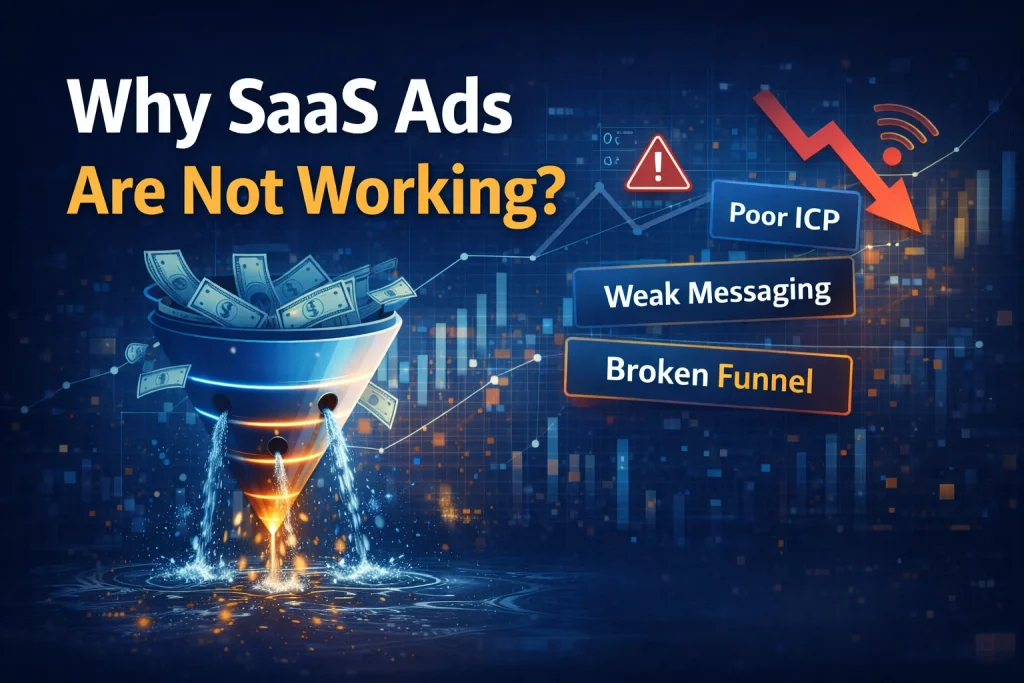
Many early-stage SaaS companies believe their biggest challenge is generating leads. So they invest in ads, try multiple channels, and experiment with campaigns.
But results often look like this:
- Low-quality leads
- Poor conversion
- Rising CAC
- Inconsistent pipeline
The problem is rarely the channel. It is the foundation.
Why SaaS Startups Waste Money on Marketing
1. No Clear Ideal Customer Profile (ICP)
One of the most common SaaS marketing mistakes is targeting too broadly. Teams try to reach:
- Multiple industries
- Different company sizes
- Various job roles
This creates confusion in messaging and weakens conversion. If your ICP is not clearly defined, your marketing will not work.
2. Messaging Is Not Tied to Pain Points
Most SaaS messaging focuses on features, capabilities, and product descriptions. But buyers care about problems, outcomes, and business impact. If your messaging does not reflect real pain, users will not convert.
3. Misalignment Between Ads and Landing Pages
A common issue in B2B SaaS lead generation: the ad promises one thing, but the landing page says something else. This breaks trust and reduces conversion rates.
4. Optimizing Channels Instead of Strategy
Founders often ask: Should we increase ad spend? Should we try LinkedIn ads? Should we invest in SEO? But without fixing the ICP and messaging, every channel underperforms.
5. No Funnel Visibility
Most teams track leads, clicks, and traffic, but not the conversion between stages, lead quality, and drop-off points. Without this, decisions are based on assumptions.
How to Fix SaaS Marketing (Step-by-Step)
1. Define Your ICP Clearly
Start with defining the target industry, company size, geography, decision-makers, and use case.
Example ICP: “B2B SaaS founders in the US with 10–100 employees struggling with pipeline growth”
2. Align Messaging With Real Problems
Instead of saying “We provide AI-driven automation”, say “Struggling with low pipeline conversion? Here’s how to fix it.”
3. Fix Funnel Alignment
Ensure consistency across ads, landing pages, and sales conversations. The message should feel continuous.
4. Focus on Conversion, Not Just Leads
Ask yourself: Are leads becoming opportunities? Are opportunities becoming revenue? This is where real growth happens.
5. Build a Simple Revenue System
Connect targeting, messaging, channels, and sales. Growth becomes predictable when the system works.
Real Insight from SaaS Founders
In many early-stage SaaS teams: ads are running, budgets are increasing, and efforts are high—but results remain low. Because the system is broken. Once ICP, messaging, and funnel are aligned, lead quality improves, conversion increases, and CAC stabilizes.
Conclusion
SaaS growth does not come from doing more marketing. It comes from doing the right marketing. Before increasing spend, fix who you target, what you say, and how your funnel works. Because marketing without clarity is just expensive activity.
FAQs
1. Why are my SaaS ads not generating leads?
Most likely due to unclear ICP, weak messaging, or targeting the wrong audience. Ads amplify strategy, not fix it.
2. How do I reduce CAC in a SaaS startup?
Improve ICP targeting, fix messaging, and optimize funnel conversion before increasing spend.
3. What is an Ideal Customer Profile (ICP) in SaaS?
It defines your best-fit customers based on company size, industry, role, and use case.
4. Why are my leads not converting?
Because they lack intent, are poorly qualified, or messaging does not match their problem.
5. Should early-stage SaaS invest in paid ads?
Yes, but only after ICP, messaging, and funnel are clearly defined.
6. What is the biggest SaaS marketing mistake?
Focusing on channels before fixing strategy.
7. How do I improve SaaS conversion rates?
Align messaging with pain points, fix funnel stages, and improve lead qualification.
8. What is a good SaaS demand generation strategy?
Start with ICP, build problem-focused messaging, and use channels that match buyer intent.
If you are an early-stage SaaS founder struggling with pipeline, CAC, or conversion, the issue is usually not execution. It is the system.